Our lab uses multiphoton microscopy to peer inside the brain for recording and modulating neural activity at the individual neuron level.
We developed a light-weight fiber-coupled head-mounted miniature two-photon microscope (< 4 grams) for imaging and stimulation in awake freely moving mice. Our miniature microscope employs electrowetting lenses for high-speed variable focusing with no moving parts in a compact design. In recent work, we have combined the fiber bundle for two-photon optogenetic stimulation in a
Publications:
B.N. Ozbay, et al., “Miniaturized fiber-coupled confocal fluorescence microscope with an electrowetting variable focus lens using no moving parts,” Optics Letters 40(11): 2553–2556.(2015) https://www.ncbi.nlm.nih.gov/pmc/articles/PMC4517461
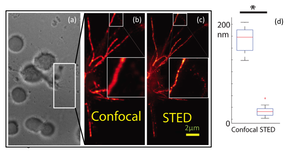
Superresolution microscopy Our lab is developing Stimulated Emission Depletion (STED) microscopy for high-speed imaging of live neurons at resolutions of ~ 40-50 nm. In collaboration with Professor Diego Restrepo, we have used STED microscopy to image extremely small (< 100 nanometers) calcium microdomains in olfactory sensory neurons, important for signal transduction in olfaction.
Additional neuroscience studies that can be performed using super resolution STED microscopy include studies of dendritic spines, involved in learning, myelin, important for problem solving, motor coordination and sensory input, synapses, key for transmission of the neural signal and primary cilia, important in neuronal differentiation.
In collaboration with Juliet Gopinath at University of Colorado Boulder and Mark Siemens at University of Denver, we demonstrated STED imaging through a flexible fiber with the goal of use in freely moving and behaving animals.
Voltage Recording in Freely Moving Animals
A collaborative effort between our group, Columbia, and the University of Colorado Boulder aims to develop novel miniature optical neural interface technology for voltage imaging and optogenetics in freely moving animals.